
For over a decade, digital marketers have worshipped at the altar of the "click." The logic was simple: if a user didn’t click on your ad and make a purchase directly, that ad didn’t work. This methodology, famously known as Last-Click Attribution, became the unquestioned standard of truth in performance marketing.
But the advertising ecosystem has evolved. Today's consumers don't just sit at their desktop computers clicking banners. They consume content across a fractured landscape of streaming platforms, digital radio, podcasts, YouTube, and social media. In this new world, optimizing for the last click is not just inaccurate—it’s actively holding your brand back from scalable growth across all high-impact mediums.
Understanding the "Halo Effect"
When you run a high-impact Connected TV (CTV) commercial, a gripping podcast sponsor read, an engaging YouTube integration, or a streaming audio spot, you are planting a seed. The viewer sitting on their couch might see your ad for a new D2C mattress on Hulu. Or maybe they hear it while driving during their favorite podcast. They don't typically pause their show or pull over their car, grab their laptop, search for your exact URL, and buy it immediately.
Instead, they remember your brand. A few days later, they go to Google and search for "best mattresses for side sleepers." They click on your Paid Search ad, go to your site, and convert. Under a last-click attribution model, Paid Search takes 100% of the credit. The CTV ad, the podcast sponsorship, or the YouTube video that actually did the heavy lifting of generating demand? It gets zero credit.
This phenomenon is known as the Halo Effect. High-funnel, high-impact channels like CTV, YouTube, podcasts, broadcast TV, and digital audio create a massive lift in brand awareness that trickles down to performance channels. Disconnecting the two leads brands to cut budgets from their most effective awareness drivers, incorrectly believing they aren't working because they aren't directly driving the final click.
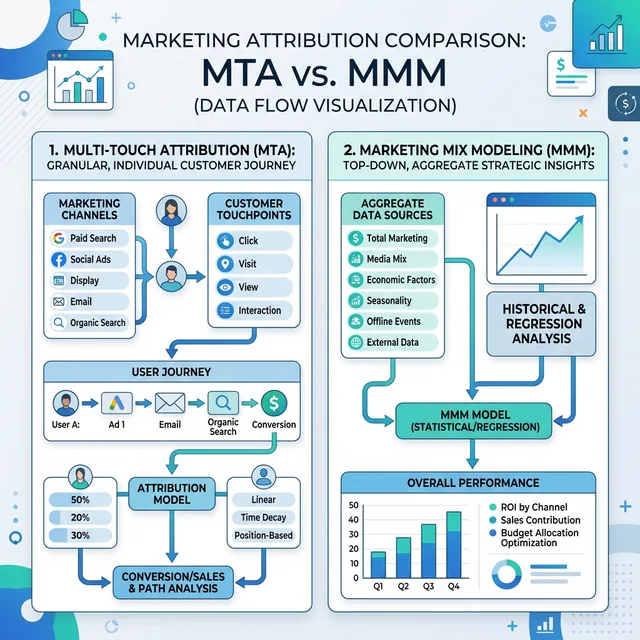
Last-Click View (MTA)
- Search and Retargeting get all the credit
- CTV, Podcasts, and YouTube appear as negative ROI
- Ignores offline sales and Amazon conversions
- Heavily disrupted by iOS14 and cookie deprecation
Incrementality View (MMM)
- Video & Audio credited for the lift they generate
- Understands the total media mix synergy
- Captures the "Halo Effect" on retail & Amazon
- Privacy-safe and resistant to signal loss
Why MMM is Replacing MTA
Multi-Touch Attribution (MTA) relies heavily on user-level tracking (cookies, pixel fires, device IDs). Over the last three years, privacy regulations and technology updates—like Apple’s App Tracking Transparency and Google’s phasing out of third-party cookies—have made tracking individual user journeys nearly impossible, especially across diverse mediums like podcasts and linear TV where a clickable link frequently doesn't exist.
Enter Marketing Mix Modeling (MMM). MMM doesn't track users; it models the statistical relationship between ad spend and sales outcomes across every channel. Next-generation predictive modeling platforms, such as Prescient AI, allow brands to understand true incrementality. They can finally prove that investing in top-of-funnel channels generates net-new revenue that wouldn't have occurred otherwise.
Did you know? Brands that switch from last-click measurement to predictive modeling (MMM) consistently see a 20-30% improvement in overall Return on Ad Spend (ROAS).
What Brands Must Do Next
If you're still making budget allocation decisions using out-of-the-box Google Analytics reporting or native platform dashboards, you have a massive blind spot. Facebook will claim Facebook drove the sale. Google will claim Google drove the sale. Nobody is advocating for your podcasts, your YouTube pre-rolls, or your CTV.
Omnichannel brands must pivot to a triad approach: platform reporting for intra-channel optimization, post-purchase surveys (HDYHAU) for customer sentiment, and MMM for overall incrementality and budget liquidity across all media types.
Don't let last-click attribution stifle your growth. By embracing the Halo Effect and utilizing proper measurement frameworks, brands can confidently scale into premium streaming, audio, and video environments knowing the exact impact it's having on their bottom line.